
Arriving in China (2026): Arrival Card, Immigration and Getting to the City
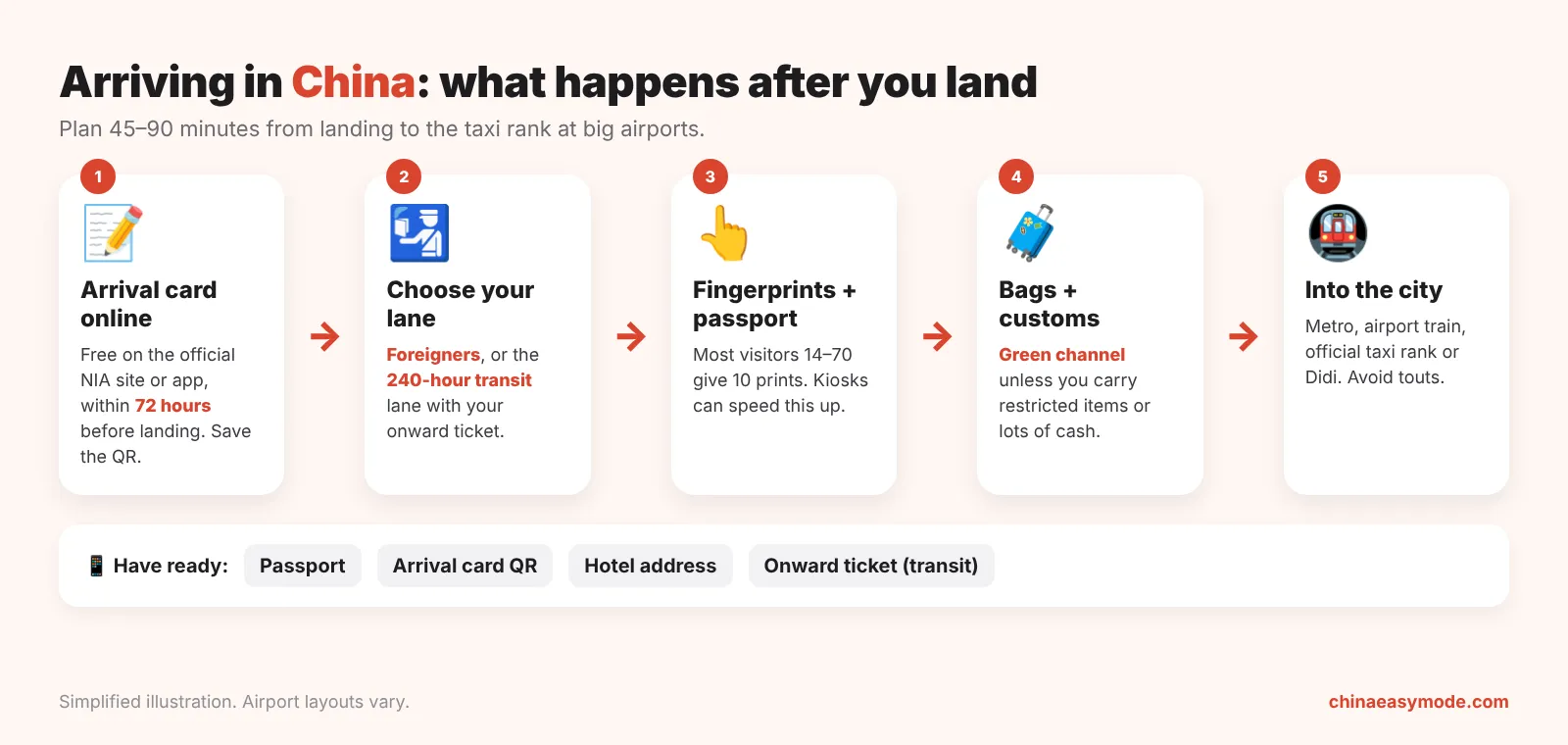
Short answer: Fill in China’s free online arrival card within 72 hours before you land and save the QR code. On arrival: follow Arrivals → queue at Foreigners (or the 240-hour transit lane if you’re using visa-free transit) → give fingerprints → collect bags → walk through customs. Budget 45–90 minutes from landing to the taxi rank, then take the metro, airport train or a taxi into the city.
Quick checklist before you board
Section titled “Quick checklist before you board”- Arrival card filed (within 72 hours of landing) and the QR code saved as a screenshot.
- Your hotel name and address saved, ideally in Chinese, copied from your booking. You’ll need it for the card, for officers, and for Didi or a taxi.
- Your travel eSIM installed before you fly.
- Alipay or WeChat Pay set up with your foreign card.
- Entering visa-free? Check your nationality and days with our visa-free checker. If you’re transiting, keep your onward ticket to a third country or region easy to find.
Payment apps to install before you fly (Alipay works for almost everything; WeChat Pay is the backup):


Before you fly: the online arrival card
Section titled “Before you fly: the online arrival card”Since 20 November 2025, foreign visitors complete the arrival card online instead of on paper.
-
Where: pick one of these official routes. It’s free. Ignore fake sites that charge a fee.
- Website: the official arrival card form is at https://s.nia.gov.cn/ArrivalCardFillingPC/ (switch it to English). The same address is listed in the Chinese Embassy notice cited below. The National Immigration Administration (NIA) arrival card portal is https://s.nia.gov.cn/.
- NIA sites: https://www.nia.gov.cn and the English site https://en.nia.gov.cn/.
- App: install the official NIA app, listed in the stores as 移民局12367 (NIA 12367, from the National Immigration Administration). The card below shows the store links.
- Mini-program: search NIA 12367 inside WeChat or Alipay.
 移民局12367App StoreGoogle PlayOn the App Store it is listed as “移民局12367” (National Immigration Administration). There is no Google Play version: on Android use the WeChat or Alipay mini program.
-
When: within 72 hours before arrival. You can’t file earlier.
-
What you need: your passport, your flight or vehicle number, arrival date, and where you’ll stay (full address in China).
-
240-hour visa-free transit? You still need the card. Pick the transit option and enter your onward flight. See visa-free entry rules.
-
Save the QR code as a screenshot. You may not have internet when you land.
Filling it in on the NIA 12367 app
Section titled “Filling it in on the NIA 12367 app”- On the home screen, tap Foreigner Service (the blue section with a globe icon).
- Under Business Processing, tap Arrival Card.
- On the Arrival Card Filling page, choose Entry Declaration in the top banner. Don’t choose Border Area Residents unless you hold a border resident certificate.
- Photograph your passport identity page. Your name, date of birth and passport number fill in automatically. Check them.
- Enter your transport type, flight or vehicle number and entry port city.
- Choose your purpose of visit. Enter your phone number with country code, your email and your full address in China.
- Confirm the declarations and submit.
 Have your passport and hotel address ready before you open the app.
Getting the QR code
Section titled “Getting the QR code”On the website, the QR code appears as soon as you submit the form. Take a screenshot straight away and save it to your phone so it works offline. If your travel details change (a new flight, a new hotel), submit a new form to get a new QR code.
If you haven’t filled it in
Section titled “If you haven’t filled it in”You can scan the QR code at the immigration inspection area, use the self-service devices, or fill in a paper arrival card. Expect a slower queue than if you’d filed in advance.
Step by step after landing
Section titled “Step by step after landing”- Follow “Arrivals”. At some airports, such as Shanghai Pudong’s satellite gates, a short train takes you to the main terminal first.
- Pick the right immigration lane.
- Foreigners: most visitors, including those using 30-day visa-free entry.
- 24/240-hour visa-free transit: if you’re transiting. Have your onward ticket ready to show.
- Fingerprints. Most foreigners aged 14–70 give all ten fingerprints. Some airports have kiosks before the desks that do this in about 90 seconds and shorten your time at the counter.
- At the desk: hand over your passport (and arrival card QR if asked). Officers may ask about your hotel, how long you’re staying and your onward flight. Answer simply and consistently with your card.
- Bags, then customs. Use the green channel unless you carry more than about ¥20,000 or US$5,000 in cash, commercial goods, or restricted items (fresh fruit, meat, some medicines, drones).
- Exit into the arrivals hall. Once you’re through, connect your phone, then follow signs for the metro, airport train, taxi rank or the ride-hailing pickup zone (网约车).
At Shanghai Pudong (PVG)
Section titled “At Shanghai Pudong (PVG)”- Fingerprints: foreign arrivals can register them at self-service collection areas. In Terminal 1, look near Gate 17 and at the entrance to the immigration waiting hall. In Terminal 2, look near Gates 75 and 77.
- Arrival card desks: they sit near the fingerprint areas in both terminals. Sample cards are available in seven languages.
- 240-hour visa-free transit: register your fingerprints, fill out the Arrival Card for Temporary Entry Foreigners, then apply for a temporary entry permit and clear inspection at any foreigner inspection channel. Bring your travel documents, onward ticket and arrival card.
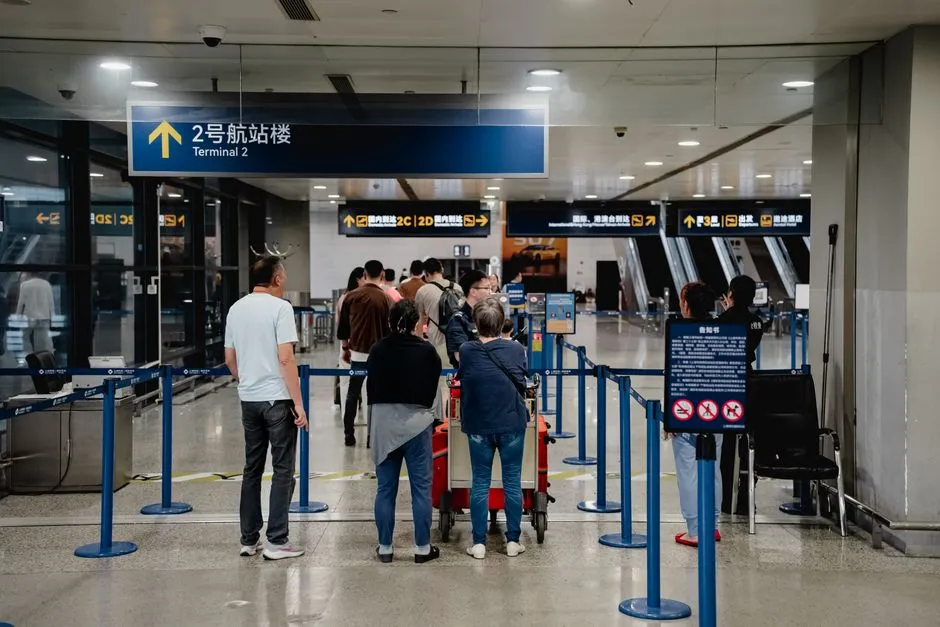 Passengers queueing at Pudong Terminal 2.
In the arrivals hall
Section titled “In the arrivals hall”- Get online: your travel eSIM should connect as soon as you land. If not, phone counters (China Mobile, China Unicom) sell tourist SIMs with your passport.
- Pay: Alipay and WeChat Pay work at the airport. Withdraw a little cash (¥300–500) from a bank ATM as a backup.
- Free Wi-Fi usually needs a passport scan at a kiosk, and blocked apps won’t work on it anyway.
Getting to the city
Section titled “Getting to the city”Shanghai Pudong (PVG)
Section titled “Shanghai Pudong (PVG)”| Option | Time | Cost | Notes |
|---|---|---|---|
| Maglev + metro | 35–50 min | ¥50 (¥40 with same-day boarding pass) + metro | Maglev ends at Longyang Road, not downtown; last trains around 21:40 |
| Metro Line 2 | ~70–90 min | A few yuan | Cheapest; pay with Alipay’s metro QR code |
| Taxi | ~50–60 min | ~¥180 to People’s Square | Use the official taxi rank only |
| Didi | Similar to taxi | See in-app price | Follow signs to the ride-hailing pickup zone. See Didi guide |
Didi: use the official app below, or open the Didi mini program inside Alipay.

Landing late, with luggage or kids? A pre-booked car meets you in arrivals with a name sign, so no queue and no app setup needed: Pudong airport transfer. Taking the Maglev? You can buy a Maglev ticket in advance and skip the ticket machines. (affiliate links)
Beijing (PEK Capital / PKX Daxing)
Section titled “Beijing (PEK Capital / PKX Daxing)”| Option | Time | Cost (approx.) | Notes |
|---|---|---|---|
| Capital Airport Express (PEK) | ~20–30 min to Dongzhimen | ~¥25 | Then change to the metro |
| Daxing Airport Express (PKX) | ~20 min to Caoqiao | ~¥35 | Then change to the metro |
| Taxi / Didi | 40–90 min | ~¥100–200 | Depends heavily on traffic |
Want a driver waiting at arrivals? Fixed price, English booking, no taxi queue: Beijing Capital (PEK) transfer · all Beijing airport transfers, incl. Daxing. (affiliate links)
Times and fares change. Check the airport’s official site or Amap on the day.
Heading to another city?
Section titled “Heading to another city?”Many travellers connect straight on to a train after landing. Set up the train app before you fly: see how to buy tickets on 12306 with your passport (verification can take up to ~24 hours, so register early) and our high-speed train guide. The official 12306 English site is https://www.12306.cn/en/index.html.

Common problems
Section titled “Common problems”| Problem | Fix |
|---|---|
| Forgot the arrival card | Scan the QR code in the immigration area, use the self-service devices, or fill in a paper card |
| Transit lane: officer asks for proof | Show your confirmed onward ticket to a third country or region |
| Travel details changed after filing | Submit a new form to get a new QR code |
| eSIM not connecting | Turn on data roaming for the eSIM line and restart your phone |
| Touts offering taxis inside the hall | Ignore them; use the official taxi rank or Didi |
| Didi shows “network error” at the airport | Switch Wi-Fi off and use mobile data, and turn off any VPN. Or open Didi inside Alipay |
| Can’t find the Didi pickup | Follow signs for 网约车 (ride-hailing); pickups are only in designated zones, often in a car park |
Next steps
Section titled “Next steps”Is there still a paper arrival card?
Section titled “Is there still a paper arrival card?”The online card replaced it as the standard. Airports still have kiosks or forms for people who didn’t file in advance.
Who doesn’t need to fill in the arrival card?
Section titled “Who doesn’t need to fill in the arrival card?”According to the Chinese Embassy in Canada (notice of 23 October 2026), you can skip it if you:
- hold a Chinese Foreign Permanent Resident ID Card
- hold a Mainland Travel Permit for Hong Kong and Macao Residents (non-Chinese nationals)
- travel on a group visa or enter under a group visa exemption
- are on a 24-hour direct transit and don’t leave the airport’s restricted area
- arrive and leave on the same cruise ship
- enter through a fast-track (expedited) channel
- are a foreign crew member of the plane, ship or train you arrive on
Everyone else, including 240-hour visa-free transit travellers, needs the card.
How long does immigration take?
Section titled “How long does immigration take?”Often 20–45 minutes at big airports, longer when several long-haul flights land together.
Do I need to register my hotel stay?
Section titled “Do I need to register my hotel stay?”Hotels register foreign guests automatically when you check in with your passport. If you stay with friends, they should register you at the local police station within 24 hours.
Does the online arrival card replace my visa?
Section titled “Does the online arrival card replace my visa?”No. The card is a declaration, not permission to enter. You still need a valid visa or a visa-free entry that applies to your passport. Rules differ by nationality. For example, the 30-day unilateral visa-free list (which includes the UK, Germany, France, Italy, Spain, Australia, Canada and others) currently runs until 31 December 2026. Check your own country in the visa-free checker and visa-free entry rules before you book.
Do I need to print the arrival card QR code?
Section titled “Do I need to print the arrival card QR code?”No. Take a screenshot and keep it on your phone so it works offline. If you haven’t filled it in, you can use the self-service devices or a paper card at the airport. Whether officers also want a printout: check before you go.
Can I use Uber or Grab from the airport?
Section titled “Can I use Uber or Grab from the airport?”No. Neither operates in mainland China. Use Didi (best inside Alipay), the official taxi rank, the metro or an airport train. See the Didi guide.
What if my phone has no signal when I land?
Section titled “What if my phone has no signal when I land?”Your saved QR screenshot still works offline. For data, turn on roaming for the eSIM line and restart, or buy a tourist SIM at a China Mobile or China Unicom counter with your passport.
Still stuck?
Section titled “Still stuck?”Use the steps above, check your trip with our visa-free checker, or ask a real person.
Sources: National Immigration Administration online entry card at s.nia.gov.cn (launched 20 Nov 2025) and en.nia.gov.cn; exemptions from the Chinese Embassy in Canada notice (23 Oct 2026); as summarized by ExpatDen (Oct 2026) and Trip.com; Shanghai arrival steps and fares from Shanghai Tourism arrival guide and the Shanghai government transport page. Visa-free lists and dates from the National Immigration Administration (checked 18 Oct 2026). Fares and timetables change. Check before you travel.Chat with Pablo
Real person, replies within 24h (usually faster). Paid help from $15; quick questions welcome.
Open WhatsApp chat WhatsApp: scan with your phone
 WeChat: scan, or save and open in WeChat
WeChat ID: qingapple1992